Tuesday, June 26, 2012

San Cristobal Colon de las Casas to Las Guacamayas

We left San Cristobal on last Monday in a rather small, well-used, rented car, loaded to the gills with our stuff. Our goal for the next 8 days: tour the State of Chiapas. Our itinerary will take us from the high mountains San Cristobal to the hot humid lowlands in the south, east to spend some time on the edge of dense, virgin selva or jungle - a large protected biosphere area, visiting at the same time a number of renowned ancient Mayan cities - Bonampak, Yaxchilan, and Palenque. This area is populated, but only lightly.

Day 1: We drive a few hours south to El Chiflon - a park that is home to the state's largest waterfall. The falls and river divides two communities who have had a hard time coordinating management of this shared resource. So there are two separate entrances and two separate trails to the falls (!!). The trail was in great shape; this is a slow part of the year, so we had the park virtually to ourselves. The park also has a zipline that shoots you twice across the gaping ravine cut deep by this surging river.

We spent the night in a horrible hotel in La Trinitaria. Safe but gross. Dogs and roosters were out carousing all night. A poor dog on the roadside, who had been hit by a car, howled mournfully all through the night as well. Noisy and unsettling.

Day 2: We visited Los Lagos de Montebello en route to Las Guacamayas, a little tourist destination on the edge of the jungle biosphere. In the rain, we hiked into the Cenote de Bartholomew on the edge of the park of Los Lagos. A cenote is deep hole in the ground filled with groundwater. They usually have steep walls all the way around. No visible water flowing in or out. They were once (perhaps still?) revered by the Maya as sacred places; they would pilgrimage to them to pray and offer valuable items as supplication to the gods. This particular cenote was called Bartholomew after the man who apparently fell into it several hundred years ago and drown.

Photos below.

Cocal Cola has amazing access to the pockeybooks of Mexicans - virtually all the drinks in Mexico are brought to you, courtesy of the Coca Cola Company: soft drinks and bottled water. Their advertising is everywhere.

Fields of miaze are everywhere. One cannot understate how important this crop is to the diet and history and economy of Mexico. Prehispanic "mexicans" domesticated it (along with peppers, tomatoes, cacao, various fruits). Much of their religious supplications were devoted to appealing to their gods of corn.


Cattle pasture is carved out of a lot of virgin rain forest.
Arriving at the Falls.

The Bogaards at the Falls - 120 meters high.

Liesl on the zipline.

Jeremiah comes flying in.


We are now in a new park - the Lagos de Montebello. Lots of lakes and water. This one is kind of green.


This one is more of a turquoise.

Lots of wetness, lots of mushrooms.

This is looking down into the cenote. It was raining. We spent a good bit of time talking with the vigilante (guard) and the guia (guide) in the area. These are remote areas, lots of poverty. And everyone has stories of America - they've been there, they have family there...The people that we met have always been gracious and welcoming.

This tree is full of bromeliads - plants that grow on top of the branches and trunks of other plants.

Bromeliad close-up.

oxen and mules and burros and horses still do lots of work in Mexico.

We have left the wet (we are in the rainy season), warm lowlands and are heading into the mountains of rainforest en route to Las Guacamayas, our destination for a few days. The communities in the mountains became quite sparse and quite rare. Tropical trees and water were everywhere.

A river surging below in the valley.

This river is surging, full of silt.

We encountered this black vulture eating on roadkill - which turned out to be a howler monkey.  Other roadkill we encountered: skunks, armadillos, a vulture, iguanas, turtles, and of course dogs, lots of dogs.

This is apparently a newly planted bio-fuel plantation, carved out of rain forest. Some kind of nut or palm from which they press oil.

The nut grows in huge clusters.


Monday, June 18, 2012

Local Mayan Villages: Zinacantan and San Juan Chamula

So today the four of us spent the day visiting two pueblos outside San Cristobal de Las Casas: Zinacantan and San Juan Chamula. Both are villages populated almost entirely by Mayan people. They are about 20 minutes away. We went as part of a little tour. Our tour guide Alonso was great - articulate, informed, and ready to talk about various issues.

Zinacantan is located in a fertile valley, filled with small homes, agricultural fields, and greenhouses. Lots of greenhouses where they grow a huge variety of beautiful flowers - roses, carnations, asters, irises, and a bunch of tropical flowers that I cannot name.

This town is run by its indigenous inhabitants. The town has an entrance fee. It costs 15 pesos for each person to enter. Their first language is Tzotzel - an old Mayan language. Some also speak Spanish. The community is relatively isolated, and their economy seems to be largely based on traveling to San Cristobal to sell their amazing flowers and textiles.

There is a Catholic church in the center of town which serves as a hub of activities. This is where we went first - to the church, to the market nearby, and then to a women's cooperative that sells a variety of woven goods.

It is clear that the Catholicism practiced here has been heavily influenced by the Mayan people and their pre-european traditions. They have their own church hierarchies, and unique practices and roles for prayer. They have little chapels on the tops of nearby mountains, for example, where their religious authorities/leaders go to pray for the sick, for the community, for the harvest, etc. Sickness here is thought to have often been brought on by sins and bad behavior in the community.

It is quite fascinating to learn about and ponder, if only at the superficial level of a morning visit.

After Zinacantan, we went to Chamula and visited the church there. This was wild. What we saw on Sunday afternoon was an indescribable blend of catholic ritual and what must be based on original Mayan beliefs. (No cameras were allowed in the church, so I couldn't take any photos.)

We stepped inside the church. It seemed like chaos to us. There were several hundred people (all Mayans) involved in various independent family-based rituals, and a couple of handfuls of visitors from outside. No pews. The air was thick with the scent of incense - Copal, derived from tree sap and used as an incense in religious rituals since long before the Aztecs. The church was filled with smoke. Pine needles covered the floor - a symbol of Nature brought into the church. And candles. Thousands and thousands of candles. Young kids were running about - laughing and playing. Six workers were reassembling a wooden structure along a wall that reached all the way to the ceiling. They were using block and tackle to raise 8 foot painted wooden columns. Men were hanging from rope, spray-painting the structure to highlight details.

Meanwhile, amidst the ropes and paint and smoke and incense, families were coming and going - lighting candles, drinking posh - sugar cane liquor - along with Coca cola and other soft drinks. Most people were sitting on the floor, praying. Some had chickens that were used to take away disease and bad spirits from people, at which point the chickens were killed right there in the church.

All along the floor, at the base of the walls were a series of models or wooden statues of Christ, John the Baptist, and dozens of other Catholic saints. People come daily to the church to ask for help (restored health for loved ones, etc) and to offer thanks for help granted.

Women and girls were all dressed alike in heavy skirts and blue and purple embroidered shawls. the men wore black wool jackets that looked as though they were sheep skin. They had a simple cut, something like a one size fits all sort of poncho/pull-over.

It was a wild, confusing, chaotic, fascinating scene. I am not sure that the Pope would approve of what his flock was up to in this particular parish…


This is a typical scene in this area - fields of recently planted corn, maize.

This is the Catholic Church in Zinacantan. These people are awaiting the appearance of a bride and groom who had just been married.

Women in the community, in their traditional village clothing - purple shawls, thick black skirts. The shawls are beautiful, embroidered with flowers and birds...

More women outside the church.

Waiting for the bride and groom.

These were some local Mayan kids in Zinacantan.

A textile co-op that we visited, filled with locally-produced, hand-woven materials that this community is famous for.

Joseph in traditional marriage clothing.


Bride and Groom.
Amy and the kids in traditional clothes.

Familial bliss.

This is an altar at the textile co-op, set up by the elder man in the house, who used to be a religious leader in the community. The clay animals in front represent spirit animals, like guardian angels perhaps for Catholics, that accompany people throughout their lives. Another example of how the new world and old world religions have been combined.


This is the church in Chamula. Inside was this amazing scene of people, incense, construction candles, prayer, and so on.

Details on the church facade.

Sunday, June 17, 2012

El Canon de Sumidero y Chiapas del Corzo

On our first full day in Chiapas, we joined a tour to visit the Sumidero Canyon and a nearby community called Chiapas del Corzo.

The Canyon trip was pretty, but not particularly satisfying beyond that. We were moved like cattle in large motorboats up and down the river - flatwater as the result of a downstream dam completed in 1980. There was little information or background from our guide.

The most memorable - and heart-breaking - story about this canyon I learned independently. In the 16th century, when the Spaniards eventually invaded this area, a fierce battle erupted with a local Mayan community on the lands high above this river. These people had heard plenty about the ways of the Spaniards, but had not yet encountered them. They put up a good fight, but in the end proved no match for guns and steel.  Recognizing their defeat, they refused to surrender and become slaves to the invaders. Instead, they gathered up their children in their arms and jumped off the cliffs above the canyon of Sumidero, falling several thousand meters to the rocks and rapids - and to their death - below. Awful.

After our journey on the river, we visited a small town nearby, before climbing back into the mountains of the Sierra Madre de Chiapas. The highlight of Chiapas del Corzo was the Pozol de Cacao - a cold cacao/cinnamon/maize drink served traditionally in a coconut half-shell. Very tasty indeed.


This the motorboat we climbed into to tour el canon sumidero. There were probably 50 passengers. Mooo.


Liesl and J - it was windy...


See the face of the monkey on the rock face?


This is one of several spider monkeys that we passed.


This is called the Christmas Tree - a formation of water and minerals and plants. At the top of the Christmas tree an underground river flows out of the canyon wall and creates this rather wild formation.

Freshwater crocs live along the banks of the river.

A good view of the immense size of the canyon walls.

Look carefully among the rocks and roots and you can see a gaggle of cute little baby crocs sunning themselves near the banks of the river. Mama Croc was in the river, just a few feet away. They are highly protective of their young'ins.


The Bogaards in Chiapas del Corzo.


Hanging from the ceiling of this giant brick gazebo in the plaza were a few dozen tiny bats.

Amy and kiddos ordering yet another ice cream cone...can you have too many?

Bienvenidos a Chiapas - San Cristobal Colon de Las Casas

Last week, we closed up shop in Puerto Escondido - took the kids out of school (but not before hosting a good bye/thank you party for each of their classes), packed up our things, sold the kids' used 1000 peso surfboard for 700 pesos ($100 and $70 respectively), said our goodbyes to new friends, and jumped on the overnight bus for San Cristobal Colon de Las Casas in the high in the Sierra Madre in the heart of the state of Chiapas.

San Cristobal is like no other Mexican city that we have visited. First of all, we are high in the mountains - at more than 4000 feet in elevation. Outside of town, just beyond the fields of maize and vegetables are dense, verdant forests of pines, oaks and a whole lot of other trees and bushes that we don't recognize. We are deep in Mayan land and culture. The local people, the foods, the clothes, the art, the crafts, the textiles are quite distinct. We are cold for the first time in months. So far, we haven't seen many new birds, but we have seen spider monkeys and freshwater crocodiles.

This city is nestled in a rich valley. The buildings are colorful, 1-3 stories max. Narrow one-way streets with narrow uneven sidewalks. There are rich bottomlands that are growing crops immediately adjacent to some neighborhoods, and all of it is surrounded by low mountains covered in thick forests. The city was "founded" about 500 years ago by the Spaniards, after they pushed the original inhabitants aside. It has undergone a number of name changes. San Cristobal today refers to the city's patron saint. "De Las Casas" refers to/honors the bishop Barthomew de las Casas who came to live in the city soon after its founding, fell in love with the Mayan people, and became a serious thorn in the side of rich and powerful in town as he became a tireless advocate for better treatment of the terribly oppressed Mayan people.

There are today some clearly defined color lines in this city. The indigenous people are on the outside of whatever it is you might be talking about. There are exceptions, but by and large light-skinned people own and operate the brick and mortar buildings in the center of town. The Mayan people in the center are mostly on foot or have set up little booths - selling their handmade textiles - bracelets, necklaces, scarves, shirts, sweaters, etc. Some very beautiful things. They come into town in the morning and leave in the evening. They are outside the center of town, outside of the established economy, and, based on all the photos of the politicians running for office / re-election, they are largely out of the political establishment as well.

I can't quite figure out this city. It has a wonderful, warm, but slightly unreal atmosphere. We are in a remote area in one of Mexico's poorest states. This city, however, is vibrant and cosmopolitan. Many people here are well-educated. Many speak english. There are people from all over the world - both visitors as well as residents. Restaurants here feature food from Italy, Argentina, Lebanon, Columbia, France. It is a major tourist destination. Much of the food is more expensive than in Puerto. Beer, for example is nearly three times the cost (So Amy and I recently invested in a medio-litro of cane sugar Mayan moonshine, flavored with cinnamon - called posh here which means "medicine" - you know...to keep our costs down).  I saw the first Asians here since I arrived in Mexico. We took a tour today to several nearby Mayan communities with Italians, Israelis, and Mexicans. Lots of bookstores and textiles stores, jewelry and amber shops, but also the traditional chaotic, packed food and textile markets and vendors that set up and tear down every day.

We are spending 3 days here exploring the city and the outlying areas before we depart for visits to other smaller Chiapan communities and locales.

Below are a few images of the city - the Zocalo (Mexico's version of the plaza), the Cathedral, the people, the streets.

The entrance to the cathedral, adjacent to the zocalo. Mayan women in traditional dress from their village. Often thick black wool skirts and blue and purple shawls pulled over their shoulders. Very colorful, very beautiful.

Jeremiah and Liesl in our hostel room. Simple, and with hot water! His wardrobe, in contrast with the above photo is not particularly beautiful...


These two young Mayan dancers performed on the zocalo one evening, accompanied by a drum - big beautiful headdresses. The one on the left is dressed as a feathered jaguar - a powerful entity in the Mayan cosmology.


Liesl enjoying her first pina colada. Virgin, of course!


The neighborhood surrounding the cathedral and zocalo is a no-car zone (why don't more cities do this??!!). Lots of shops and cafes and restaurants. Very pleasant atmosphere.


The Cathedral in the center of town.


Saturday, June 9, 2012

Los Delphines De Puerto Escondido

Last weekend, we spent the morning out on the ocean. We hired "una lancha" - a narrow motor boat and a guide, Ivan, to take us out on the water on a tour to look for dolphins, sea turtles, and maybe fish a little as well. We left shore about 7:30 am, and planned to return before 11 in order to avoid the heat of the day.

We made our way east along the coast, past the city of Puerto, and then took a right and headed straight out to sea. The water was rising and falling in long, lazy swells. It was calm. After about 45 minutes, Amy and I began to wonder if this was really the way to find dolphins. Small fish periodically would break the surface and shoot across the water. Turtles heads and shells would also appear and disappear among the swells. After probably an hour a half, Ivan and his colleague suddenly shouted "Delphines!"

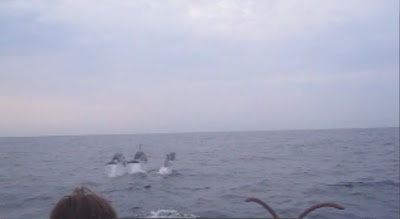
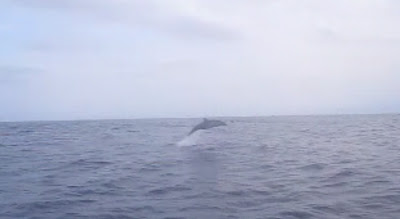
Sure enough, about 1/2 mile away, we could see dolphins shooting into the air. Apparently they regularly gather up in the morning off the coast, sometimes in the hundreds, and swim together before breaking up into smaller groups to hunt. There are a number of varieties of dolphins that frequent these waters, but we only saw white-sided or white belly dolphins. There were at least a hundred - shooting under the boat, bursting out of the water just beyond the boat's bow or beyond its wake. They seemed curious, were fantastically fast and energetic.

At one point we jumped in the water (amid hundreds of tiny stinging jelly fish, I might add). Underwater, we could hear their faint whistles in the distance. Me and kids got out after a few minutes, and then Amy got out suddenly, at the urgent request of Ivan. They had spotted a highly venomous sea snake on the other side of the boat. Only 2-3 feet long, these snakes live all their lives out in the middle of the ocean. Their bite is very dangerous, and occasionally fatal.

Here a few photos and a little video from our trip...


Liesl, at the start of the trip. 7 am.


Amy and some weird dude who kept following her around.


Our guides Ivan and Ray.


Ray jumped in the water and grabbed this turtle and he and Ivan hauled it aboard. They assured us that the turtle didn't mind. I am not so sure...After about 30 seconds, we pushed him back overboard.


Here's shot of a dolphin leaping.


Here are a few views from the boat.


This is a photo of the type of dreaded Sea Snake that Amy almost wrestled. Occasionally they get washed up on shore.

Amy and Liesl hard at work bringing dinner on board.


Mahi-mahi. We took one, and Ivan and Ray took the rest.