Wednesday, April 18, 2012

Puerto Escondido: life is everywhere

Puerto Escondido is on the coast, on the Pacific Ocean. It's tropical. This means that it is always warm and humid this time of the year. The temperatures here fluctuate here little, probably 70 and 85 degrees F. The humidity and temperature drops a little overnight, and then rises all day. Honestly, we are sweaty most of the day, though (not surprisingly) the locals all seem much better adjusted to the temperatures than we are. People on the street are often wearing more clothes than we are, and no one seems to be perspiring. Everyone/everything moves slowly. We'll see if our bodies adjust at all over the next couple of months.

Being in the tropics also means that life is absolutely everywhere. We have arrived at the peak of the mango season. The trees throughout the city are heavy with the orange-yellow-reds-greens of mango. We all eat between 3 and 6 mangoes a day. Delicious and fragrant. They regularly crash with a loud bang onto the tin roof of our rental house. One tastes like pineapple and mango. Another like coconut and mango.

This is our backyard. Three huge trees. Right now, it is just like fall with apples in the Northwest, only more delicious and more dangerous. Look out for falling fruit.

Birds are also everywhere. They are unavoidable. Warblers, flycatchers, grackles, hummingbirds, orioles. Almost all of them are colorful and showy - some intensely so. Here a few photos of the birds that we see regularly:

black-vented oriole................................................altamira oriole


white-throated magie-jay......................boat-billed flycatcher

We wake up every morning to the surprisingly loud bark of geckos that are crawling across the inside walls of our house.


On the streets, we step over the industrious traffic of ants moving leaves and vegetation and other resources from their sources to their distant underground empires.

Here is a photo of Jeremiah next to a stick bug that was climbing around our front door.


And finally, here is a poem from Liesl. On her first day of school, her assignment was to write a poem. She chose, as her subject, the 2-ft. iguana that distracted her classmates during school that day - wandering along a wall with mango in its jaws.

Iguana, laughing at us in the afternoon sun
Moving his scales to the beat of his laughter, shimmering

The juice from the mango in his mouth drips down his chin,

Finding a warm place to "splat" on the cement wall below him

He tosses it up in the air then catches it again squeezing more juice out

Sensing danger, he slips away down the wall

To a safe shady spot.


(And in spanish, courtesy of google translator, for all of you bilingues)

Iguana, riéndose de nosotros en el sol de la tarde
Moviendo sus escamas al compás de su risa, brillando

El jugo de un mango en la boca gotea por la barbilla,

Encontrar un lugar cálido para "plaf" en la pared de cemento debajo de él

Él lo lanza en el aire y luego la atrapa de nuevo apretando más jugo

Presintiendo el peligro, que se escapa por la pared

Para un lugar con sombra segura.

Monday, April 16, 2012

The World Acc. to Liesl & Jeremiah: The ride from Oaxaca to Puerto Escondido (15 Abr. 2012)

(with minor edits from JB in parenthesis) and some JB musings on the ride below that.

On the bus ride over to Puerto Escondido, everyone got very car sick. 11 people rode with us in the "suburban". (JB squished in with L and J, to give a seat to someone else who had none.) The first half of the twisty, turny ride, we read our books (much to Amy's amazement who HAS to be in the front seat and CANNOT read), but after the first bathroom break we were all about to vomit. As Jeremiah commented on the car ride: "it's like a six-hour long roller coaster ride." The mountains just kept on going, as far as we could see. Each time we climbed a mountain and looked over it, hoping to see the sea, we just saw more rows of mountains and mountains and mountains. It was not very reassuring.

The first to throw up was Jeremiah and unfortunately for Liesl, she was sitting right next to him (Liesl has an unusually low tolerance for people throwing up in her vicinity). Liesl and Papa switched places so Jeremiah could fall asleep without barfing on her. Soon after that little carsickness round, a baby started puking in the back and the woman riding in the front with Amy asked the driver to stop so she could hurl outside the bus. BIEN!

But the grossest time was when the boy sitting next to Liesl threw up. The window next to him had been opened just five minutes before and he barely made it, throwing up a little in the car.

THe funny part was that the driver was more concerned about his bus than the people barfing. There was one kid that yacked all over himself. The whole ride would have have been better if the driver weren't rushing and playing mexican rap (along with techno, pop, and LOUDLY!) At the end of the ride, we were all relieved.

WOTD: (Word of the Day): Not really a word - more of a fact: 50% of the people who ride buses on that road throw up.
==================
JB musings on the ride over the mountains


Rolling hills, arroyos secos
scattered with solitary trees, brown cornfields, agave, goat herds and one-story pueblos.
Everything in slow motion, except us.
hot, still.
Roadside dogs sleep in shade. turkeys, pigs. burros, standing still, alone.
A cemetery explodes into view: colorful flowers and ribbons: purple, red, yellow, white.
Mexican pop, rap, blaring, with woman behind me singing her own songs,
while La Madre Sagrada air freshener, hanging from mirror, struggles to keep the beat.
Impatient driver stops for 2-ft. iguana crossing road.
Endless parade of concrete block buildings, unfinished, rebar reaching toward blue sky.
No shoulder, cacti grows just beyond the white line.
People, scratching out a living from parched land.
All of us, putting our faith in God.

Sunday, April 15, 2012

Photos: Monte Alban - Oaxaca Valley's pre-european power center

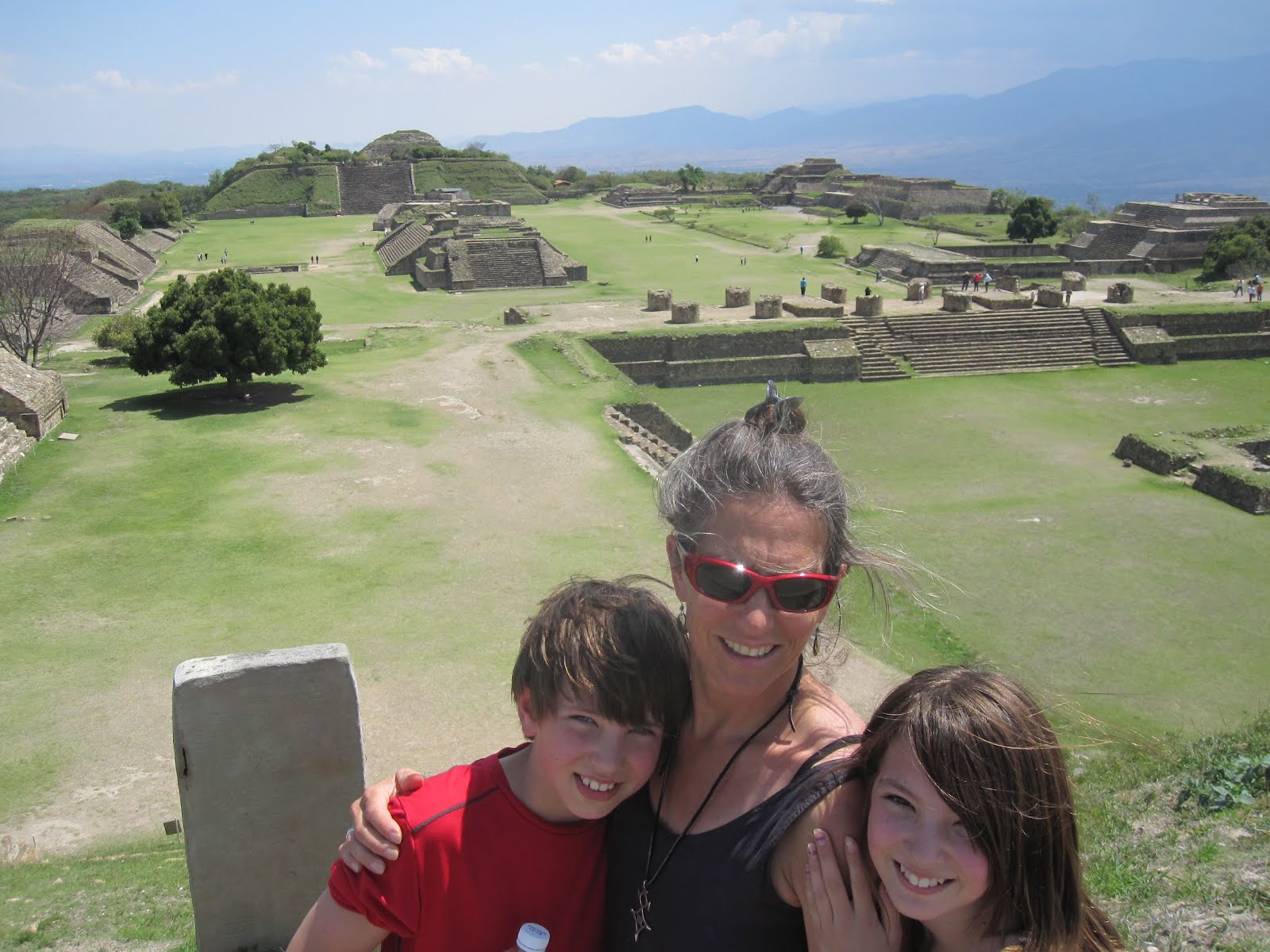
The following photos are from our visit to Monte Alban. Located on a low mountain above Oaxaca, it was the center of religious and political power for more than 1,000 years. The construction dates back to 500 B.C. for unknown reasons (drought, environmental destruction/resource depletion...), it's grip on power begun to unravel about 500-700 A.D. It was largely uninhabited when the Spaniards arrived, though the valley was full of many smaller communities of Zapotecs, Mixtecs, and others. There were at least 16 distinct, tonal languages in the valley at that time.

Monte Alban is an impressive, expansive, overwhelming place. It was the home of elite and the intellectuals, and used for ceremony, burials, astronomy, administration, ritual, etc, and relied for centuries on tribute from the many communities in the valley below.

Amy, Liesl and Jeremiah, with about half of the complex visible behind them.

This is a massive set of stairs above the "northern plaza", the size
of at least 6-8 football fields.

This is detail of one of the dozens of structures - tombs, altars,
astronomical buildings - that were constructed at Monte Alban.
Even more amazing - much of this rockwork throughout the entire
complex during its heyday was covered in white stucco/fresco, and
then painted with colorful images of people, animals, stories and
exploits, etc.

We rather randomly met this fellow, holding a "chicharra" (cicada, we think)
the insect below. He was a super-interesting, nice guy. He came from a mountain
community that regularly ate these bugs - fried in oil. He explained how they
harvest them from high in trees - with a natural glue that they placed on the
end of long, light, narrow stick.

This was a big bug! We put the chicharra in back in a bush when
we were done talking about it.

This was just another colorful beetle-like creature that we found
near the chicharra. About the size of a half dollar. We were told
they bite!

The family, atop one of the elevated areas, with much of the
complex visible behind us.

Semana Santa in Oaxaca

Semana Santa in Oaxaca

Given the importance of the Catholic faith here in Mexico, Semana Santa (Holy week or easter) is a very big deal. The schools are on vacation for two weeks, so much of the country is on the move, with many Mexican tourists visiting Oaxaca (an many other places undoubtedly).

Unlike the U.S., where primary and secondary schools generally break at a different time than colleges, the entire country takes off these two weeks. Much more importantly, most everyone celebrates the religious aspects of Semana Santa. Oaxaca exploded with people on the Monday preceding Easter Sunday. There were, however, no Easter bunnies or plastic eggs (thank goodness!), but rather purple and white ribbons hanging along the streets and churches, many flowers, beautiful figures made from palm leaves, and handmade decorations of dried flowers and agave plants adorning many doorways. The Easter celebration truly begins on Thursday night and continues through Saturday night. Most stores and restaurants were closed all day Friday and Saturday, reopening on Sunday. All in all, a very different celebration than we gringos do for Easter.

I went to my friend Rocio's house for "comida" with her family on Friday (dinner around 4:00), then we biked to a small town called Tule to visit the world's largest tree - a cypress weighing more than 600K tons, with a diameter of something like 20 feet! Rocio then decided that we needed to bike to another town - Santa Domingo - where everyone in the town makes bread. It was a surreal experience, including riding home in the dark.


Rocio and Andrea in front of the gi-normous cypress tree. Our
house on Vashon could fit inside of it. Truly.


Fresh bread in the pueblo of Santa Domingo. Most of the town
was at church while we visited. It was Friday night of Semana
Santa.


It seemed like the entire town was in this procession. Hard to
see, but these people are carrying a casket (Jesus)and are holding
Mary and Joseph overhead.

Here the procession is entering the church. This was a super clean
town.


This woman was putting flower arrangements together for the
church. I love this photo.


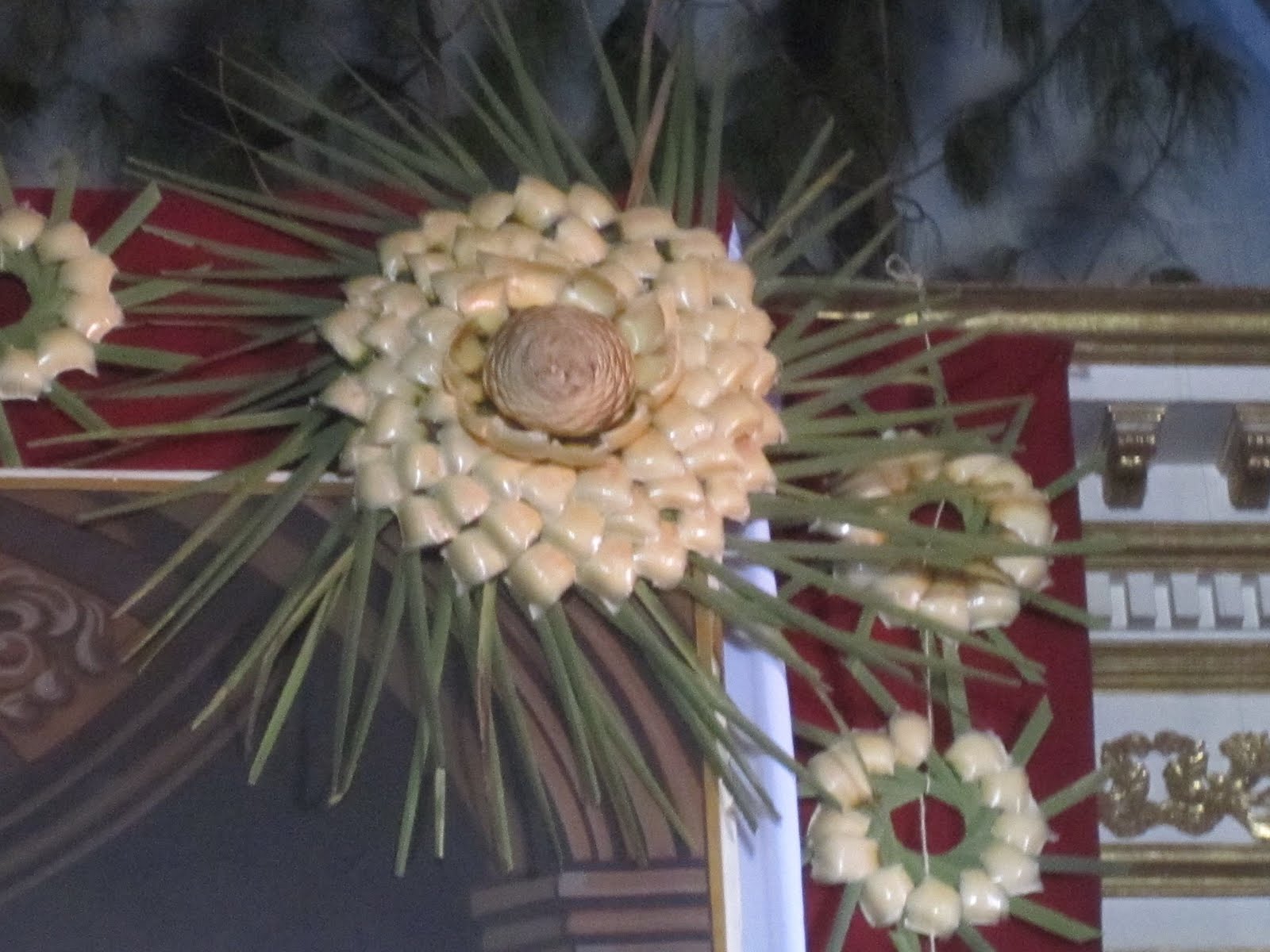
This is one of the many decorations made for Semana Santa. It
was incredible how much work was required to create these. The
entry way of many churches were adorned with weavings like these
and other dried and fresh flowers.

Monday, April 2, 2012

Visiting Puerto Escondido on the Coast.

I left Oaxaca at 11:00 at night, thinking that I would sleep and arrive in PE early in the morning. I did arrive early in the morning but because the bus driver first played a fairly violent movie and then he listened to the radio very loud all night long, I got little sleep. No big deal in the big scheme of things.

I was going to PE to determine if we would want to spend 2 months there. At first, I was not impressed. I was staying in an area known for its partying. I am not at all interested in that scene! The few beaches I visited were loaded with people. I loved the fact that everyone was laughing with excitement and playing like you rarely see here. But, because there were so many people, it was not very inviting. I had lunch and enjoyed watching all the fun, then I went to Carrizalillo beach where I found what I was looking for: a quiet cove but with waves sufficient for surfing. I am sure the waves vary from day to day but the four times I visited the waves were perfect. I took a surf lesson. Yahoo!!!

The guy with whom I took surf lessons showed me the private school where his daughter attended. I stopped by later, and director was happy to accept our kiddos for 2 months. Compared to the school I found in Oaxaca, this seemed like a better fit. The school in Oaxaca seemed very serious, a longer day, extra-curricular activities and apparently homework every night. This school seems far more relaxed. Better for our English-speaking children in a Spanish school.
Bottom line - we are going to set up shop in PE for 2 months. We still need to find a place to stay but we'll worry about that when we get there.


You can see where Carrizalillo beach is. The school
is near the gas station symbol. Hopefully we will
find a place to live in this area


This is an almond tree. Nothing like the almond trees
in the northwest. But sure enough there was an almond
inside.

Here's a mango tree. Literally all over the town.
A great source of shade and as far as I am concerned
a great source of danger. I can't tell you how many
times I almost got hit by a falling mango. It could
easily knock you out!


A papaya tree. Not nearly as prolific as the mango
trees.

Sunday, April 1, 2012

Puerto Escondido


The coast of Puerto Escondido.  There is an old 
path all along this coast line. At one time it must have 
been a beautiful walking path.  Currently it doesn't
seem very well used.  Although I hope our family will
enjoy it some.
    
 There are a handful of beaches in Puerto Escondido
This is one we will avoid unless we feel like people
watching.  All of these people were really enjoying
themselves.
 
These are waves for beginning surfers.  Hopefully
we will spend some time on this beach.
I took a surf lesson and can you imagine -I am hooked
It was sooooooo fun.
 
Here's the beach we will prefer to spend time at.


More time with Rocio and her family


Andrea and her father Isaiah.


The "abuelito" the creator. I never did learn his name.
This picture doesn't really capture his authenticity.
The entire house was hand-crafted.
You could tell he was very proud as he spoke Spanish excitedly to me for a long time even thought I couldn't understand him!


A toucan in a cage. When I went to Rocio's house
the next week I held their toucan who roams freely in the yard. (bummer - I forgot my camera).


here is another wall. There were 2 more huge walls
They are not shown here. All the floors
were mosaic marble with various animals